

SEO and PPC are the two channels most ecommerce businesses end up debating at some point. Both can drive meaningful revenue. Both have genuine limitations. And both come with strong opinions attached, usually from people trying to sell you one or the other.
This post is not that. We work with ecommerce businesses across both channels, so our view is straightforward: the right answer depends on your commercial situation, not on which channel sounds more appealing. What we want to do here is give you a clear, honest comparison so you can make that call with confidence.
What’s the Difference Between SEO and PPC?
What is SEO?
SEO (Search Engine Optimisation) is the process of improving your website so it ranks higher in Google’s organic, unpaid search results. Rankings are determined by three broad factors: the quality and relevance of your content, the technical health of your site, and the authority you have built through external signals like backlinks.
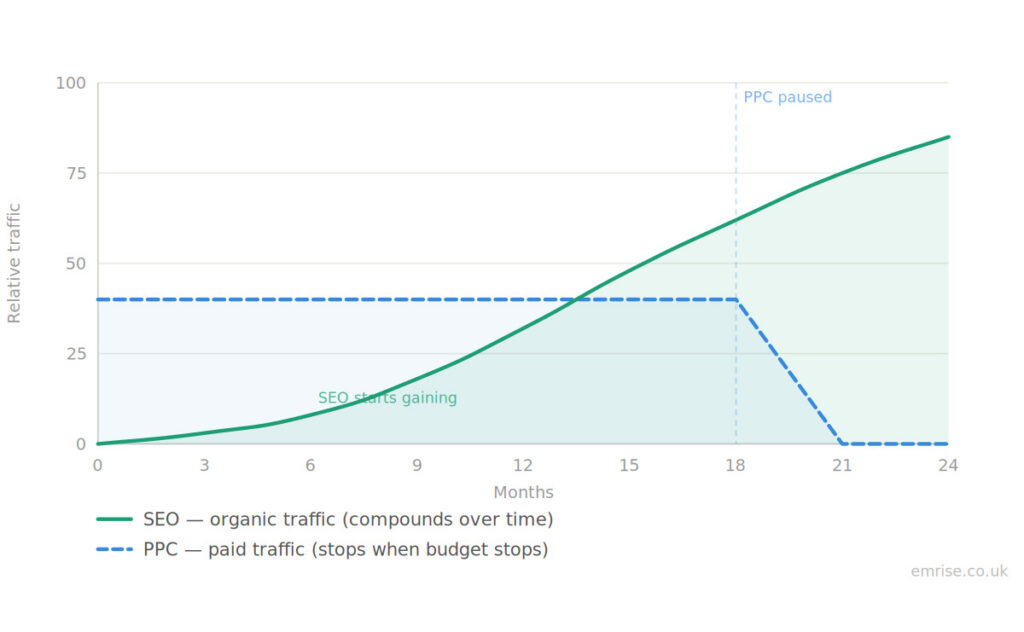
The trade-off is time. Most ecommerce businesses start to see meaningful organic movement between three and six months in, with the most significant gains coming at the twelve-month mark and beyond. The upside is that once you are ranking, the traffic does not carry a per-click cost, and the results compound the longer you invest.
It is also worth noting that the same factors that help you rank on Google are increasingly what determines whether your brand gets cited by AI-powered tools like ChatGPT and Perplexity: content quality, authority, and relevance. As more consumers use these tools to research products and brands, appearing as a trusted source across both traditional search and AI search is becoming a meaningful commercial advantage.
What is PPC?
PPC (Pay-Per-Click) is a paid advertising model where you pay each time someone clicks your ad. For ecommerce, the most relevant formats are Google Search ads, which appear at the top of the results page above organic listings, and Google Shopping, which displays your products directly in the SERP with an image, price, and store name.
Unlike SEO, results are immediate. A well-built campaign can drive traffic on day one. The catch is that the moment your budget stops, so does the traffic. There is no compounding effect, and performance is heavily influenced by how well the campaign is structured, how relevant your ads are to the search query (Google measures this through a metric called Quality Score), and how well your landing pages convert.
SEO vs PPC: The Commercial Comparison
Neither channel is objectively better than the other. They operate differently, deliver results on different timelines, and suit different commercial situations. The table below lays out the key differences clearly.
| SEO | PPC | |
| Speed to results | 3 to 6 months minimum | Immediate |
| Cost structure | Investment in content and technical work, no per-click cost | Pay per click, ongoing |
| Traffic longevity | Compounds over time, continues after work is done | Stops when budget stops |
| Long-term ROI | High (748% median over 3 years, per FirstPageSage) | Lower, but faster to realise |
| CTR and trust | Top organic result earns ~39.8% of clicks; higher user trust | Top paid result averages ~2.2% CTR; users more sceptical of ads |
| Targeting control | Through keyword and content relevance | Granular: location, device, audience, time of day |
| Best for | Long-term organic revenue growth | Immediate traffic, promotions, new launches |
A few points worth expanding on.
The cost-per-lead gap is significant. Organic search generates leads at an average of £14, compared to £44 for paid search, a cost advantage that widens as your organic rankings strengthen. That does not make PPC poor value, but it does underline why businesses that rely solely on paid traffic tend to face increasing pressure on margins over time.
The trust gap is real too, particularly for ecommerce. Users in research mode, comparing products or weighing up brands, tend to place more weight on organic results. A business appearing organically carries implicit credibility that a sponsored listing does not automatically confer.
Where PPC has a clear advantage is control. You can define exactly who sees your ads, at what time, on which device, and with what message. For ecommerce businesses running a seasonal promotion or launching a new product line, that precision is commercially valuable in a way that SEO simply cannot replicate at speed.
When SEO Makes More Commercial Sense
SEO is not the right starting point for every ecommerce business, but when the conditions are right, it is the most commercially efficient channel available over the long term. Here is when it makes the most sense to prioritise it.
You have time on your side. If your business is generating revenue and is not dependent on immediate traffic growth, SEO offers the strongest return over a 12 to 24 month horizon. The ramp-up period is real, but so is the compounding value once rankings are established.
Your product category has consistent search demand. SEO performs best when customers are actively searching for what you sell throughout the year. If there is stable, year-round search volume around your core product terms and categories, that is organic revenue waiting to be captured.
Your competitors have not yet built strong organic authority. In many ecommerce niches, organic search is still genuinely winnable. If the businesses ranking for your target keywords have weak backlink profiles, thin content, or poor technical foundations, there is a real opportunity to take ground that will be very difficult for them to reclaim once you hold it.
You want to reduce your reliance on paid spend over time. Every pound spent on PPC needs to be spent again next month. Every piece of content that ranks organically keeps working without an ongoing media cost. Businesses that invest seriously in SEO are gradually buying themselves out of paid dependency, which has a direct impact on margin.
Your customers research before they buy. For ecommerce brands where the purchase involves some consideration, such as jewellery, homewares, or considered fashion, there is significant search volume at the research stage. Ranking for category, comparison, and guide-style queries puts your brand in front of potential customers before they have even decided where to buy.
When PPC Makes More Commercial Sense
PPC is the right tool when speed and precision matter more than long-term cost efficiency. For ecommerce businesses, there are several situations where it is clearly the stronger commercial choice.
You need revenue now. If your business is at an early stage, has just launched, or is going through a period where cash flow needs to be prioritised, PPC puts you in front of high-intent buyers immediately. Waiting six to twelve months for organic traction is not a viable option when you have a business to run.
You are launching something new. A new product line, collection, or promotion does not have the time for SEO to build momentum. PPC gets it in front of the right audience from day one, with full control over the message and the targeting.
Your market is highly competitive organically. Some ecommerce categories are dominated by large retailers with years of SEO investment behind them. In those markets, ranking organically for high-volume terms is a long and uncertain road. PPC levels the playing field by letting you compete for those terms immediately, regardless of your domain authority.
You have defined seasonal peaks. For ecommerce businesses where a significant proportion of annual revenue is driven by key periods such as Black Friday, Christmas, or Valentine’s Day, PPC is the only channel that can reliably put you at the top of the SERP when it matters most. SEO cannot be turned on for a six-week window.
You want to test before you commit. PPC is the fastest and most measurable way to find out which products, categories, and messages actually convert. That data is genuinely valuable, not just for paid campaigns but for informing where your SEO investment should be focused.
One important caveat: PPC only delivers a strong return when campaigns are properly structured, actively managed, and pointing to landing pages that are built to convert. Buying traffic to a poor product page or running a loosely built campaign is an expensive way to learn very little. The channel rewards expertise and penalises neglect.
Why Most Ecommerce Businesses Should Use Both
The most common mistake businesses make with this decision is treating it as a binary choice. SEO or PPC. One or the other. In reality, the businesses generating the most consistent organic revenue are almost always running both, and there are three strong commercial reasons for that.
Each channel makes the other more effective. PPC campaigns generate conversion data quickly. You find out fast which keywords actually drive purchases, not just clicks, and which product messaging resonates with buyers. That intelligence directly informs your SEO strategy, telling you which content and category pages are worth investing in rather than guessing. Running both creates a feedback loop that neither channel can create on its own.
You capture more of the SERP. A business appearing in both the paid and organic positions on the same search results page takes significantly more real estate away from competitors. It also reinforces brand credibility. When a potential customer sees your brand twice on the same page, once in the ads and once in the organic results, the cumulative effect on trust is greater than either placement alone.
You can bridge the gap while SEO builds. One strategy we use with clients at Emrise is identifying keywords that are being actively targeted through SEO but have not yet reached page one. Rather than waiting for organic rankings to arrive, we run PPC on those exact terms in the interim, so the business is not missing out on revenue during the build phase. Once the organic ranking is established and converting, the paid spend on that term can be pulled back. It is a practical way to stay commercially active on your most important keywords at every stage of the SEO journey, not just once the work is done.
You reduce commercial risk over time. Relying entirely on PPC means your revenue is always one budget cut away from disappearing. Relying entirely on SEO means you are exposed whenever Google updates its algorithm or a well-funded competitor moves into your space. Running both means neither scenario is a crisis. As your organic rankings strengthen, you can reduce paid dependency gradually, improving margin without sacrificing revenue.
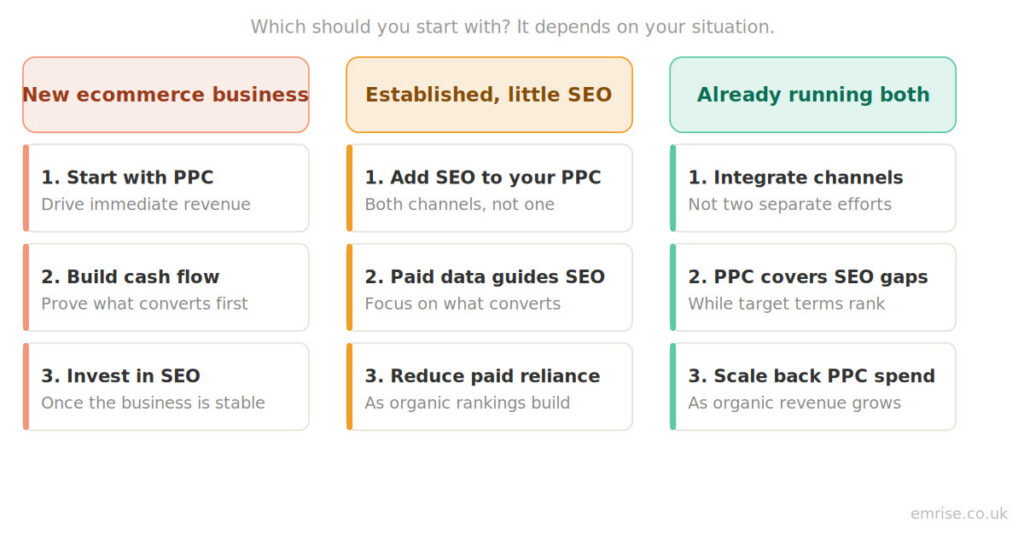
That said, where you start depends on where your business currently is. If you are a new ecommerce business, PPC should come first. Get revenue in the door, establish what converts, and build financial stability before committing seriously to SEO. Doing it the other way round is a genuine commercial risk. If you are an established business already running PPC, the smartest move is to build SEO alongside it rather than instead of it, using your existing conversion data to inform where to focus first. And if you are already investing in both, the priority should be making sure the two channels are actually working together rather than operating in isolation.
At Emrise, having SEO, PPC, development, and design under one roof means both channels are built to work together from the start. Our SEO priorities are shaped by what our PPC data tells us converts. Our landing pages are built by the same team running the campaigns. That kind of joined-up thinking is genuinely difficult to replicate when SEO and PPC are being managed by separate agencies or separate teams with separate goals.
If you want to understand how both channels could work together for your ecommerce business, get in touch with the team at Emrise. You can reach us via our contact page, email us at [email protected], or call us on +44 0115 678 7377.
Frequently Asked Questions
Is SEO or PPC better for ecommerce?
Neither is universally better. SEO builds sustainable organic revenue over time and delivers a stronger long-term ROI, while PPC drives immediate traffic and is particularly well-suited to new businesses, product launches, and seasonal peaks. Most ecommerce businesses benefit from running both, with where you start depending on your current stage and cash flow position.
How long does SEO take to show results?
Most ecommerce businesses start to see meaningful organic movement between three and six months after beginning SEO work, with the most significant gains typically coming at the twelve-month mark and beyond. The timeline depends on the competitiveness of your market, the current state of your site’s technical foundations, and the pace of content and link building activity.
Does PPC affect SEO rankings?
No. Google has confirmed that running paid ads has no influence on organic rankings. However, the two channels complement each other strategically. PPC data reveals which keywords actually convert, which informs SEO content priorities, and appearing in both paid and organic positions on the same results page increases your overall search visibility and brand credibility.
What does PPC cost for ecommerce in the UK?
Cost-per-click varies significantly by industry and keyword competitiveness. In ecommerce, average CPCs can range from under £0.50 for niche or long-tail terms to well over £3 to £5 for competitive category terms. Budget should always be set alongside a realistic target return on ad spend rather than in isolation, and agency management fees sit on top of your media spend.
Can a small ecommerce business afford both SEO and PPC?
Yes, though the scale and balance will differ. A smaller budget does not mean one channel has to be abandoned entirely. A phased approach, starting with PPC to generate immediate revenue and cash flow while building SEO in the background, is often the most commercially sensible route for smaller ecommerce businesses.


