

Type “SEO agency” into Google and you will find hundreds of options. Most will promise first-page rankings, compounding organic growth, and a strategy tailored specifically to your business. The pitches are polished. The case studies look convincing. And yet, picking the right one is genuinely difficult.
The challenge is not a lack of options. It is knowing how to separate agencies that drive real commercial results from those that drive activity. Because the two are not the same thing.
Choosing the wrong SEO agency does not just cost you their monthly fee. It costs you the months during which a better partner would have been building your organic revenue. It can mean link building that creates a Google penalty rather than authority, content that attracts traffic that never converts, and a reporting relationship that keeps you busy with charts that do not connect to your bottom line. Meanwhile, your competitors are compounding.
This guide gives you a clear, practical framework for evaluating any SEO agency before you commit. What to look for, the questions that reveal how an agency actually thinks, and the red flags that tend to appear before the problems do.
What the Right SEO Agency Actually Does
The job of an SEO agency is not to get you to page one. Rankings are a signal of progress, not the outcome. The actual job is to capture demand that already exists in search, connect it to the right pages on your site, and improve the rate at which that demand turns into revenue.
In practice, that means understanding which search queries indicate buying intent rather than general curiosity. It means fixing the technical foundations that prevent Google from properly crawling and trusting your site. It means building content that supports the full buying journey, not just informational posts that attract browsers who never buy. And it means acquiring authority through links that are editorially earned from credible, relevant sources.
The single biggest difference between a good SEO agency and an average one is prioritisation. Average agencies produce a lot of output. Good agencies decide what to do first based on commercial impact, what to stop doing when the data says it is not working, and what to push hardest on when momentum is building.
If an agency cannot explain clearly why they are doing what they are doing in terms of commercial return, that is worth paying attention to before you sign anything.
What to Look For When Choosing an SEO Agency
Commercial results, not just traffic metrics
Any agency can show you a graph of organic traffic going up. The more important question is whether that traffic produced anything for the business. Before committing to anyone, ask to see case studies that show a commercial outcome. Organic revenue growth, qualified leads generated, or a measurable uplift in sales attributed to organic search. Not just “sessions increased by 180%.”
Sector relevance matters here too. An agency with genuine ecommerce experience understands the specific challenges involved: optimising category pages for commercial intent, structuring product pages to rank and convert, managing indexation at scale, and accounting for seasonal demand shifts. That is a different skill set from an agency that has built its track record in B2B lead generation or local services.
If a case study is vague about what was actually done and what specifically changed as a result, treat that as a signal. Strong agencies document their work precisely because they are proud of the logic behind it, not just the outcome.
Technical SEO capability owned in-house
Technical SEO rarely moves rankings on its own in a dramatic way. What it does is remove the ceiling that stops everything else from working.
If Google is wasting crawl budget on thousands of low-value filter pages, or canonicals are pointing in the wrong direction, or the wrong version of a page is being indexed, those issues quietly suppress what your content and link building can achieve. You invest in the right things and wonder why results are not compounding the way they should. Often, a technical problem is the reason.
A competent agency will identify these blockers early and resolve the meaningful ones within the first month. Broken links and redirects, canonical and pagination tags, rendering and indexing issues, structured data, and for platforms like Shopify, CMS-specific issues like category paths in product URLs. These are not months-long projects. They are foundations that should be in place before the real work begins.
This is actually one of the more telling signals when evaluating an agency. If they are still focused primarily on technical fixes three or four months into a campaign, that is a red flag. It either means the initial audit missed things it should have caught, or technical work is being used to fill retainer hours rather than drive results. The agencies that generate real ROI from SEO move through technical groundwork efficiently and spend the majority of their time on the activity that compounds: content, authority building, and conversion.
Ask any agency you speak to how they approach technical SEO, what the most common issues they uncover are, and how long they expect technical work to take. If they cannot speak to CMS-specific challenges relevant to your platform, or if they cannot give you a clear answer on when technical work transitions into growth work, keep looking.
A content strategy built around buying intent
Producing blog content is not a content strategy. A content strategy maps the full buying journey and prioritises the pages most likely to drive revenue.
For ecommerce businesses, the clearest return on SEO investment almost always comes from collection and product pages first. If your collection pages are already ranking somewhere between positions four and twenty for commercially relevant keywords, a well-executed optimisation push can move them into the top three positions. That shift in visibility on pages where users are already in buying mode tends to produce a measurable revenue impact relatively quickly.
From there, expanding into new collection pages targeting non-branded, purchase-intent keywords opens up new demand entirely. These are bottom-of-funnel pages built around what buyers are searching for at the point of decision, not what they might be casually browsing.
Blog content has a role, but it is a more specific one than many agencies suggest. The content worth investing in targets middle-of-funnel queries, users who are close to a decision but need one more piece of information, such as a comparison between two products or a buying guide that helps them choose. That kind of content can convert when it is built around the right intent and naturally guides the reader toward relevant products. Purely informational top-of-funnel content, the kind that answers general questions with no commercial connection, rarely converts in a meaningful way and is increasingly being answered directly by AI tools and Google overviews before a user ever reaches your site.
Ask any agency you speak to how they prioritise content investment and where they expect the strongest return. If the answer leads with a blog content calendar rather than collection and product page performance, that is worth probing further.
Reporting that connects to revenue
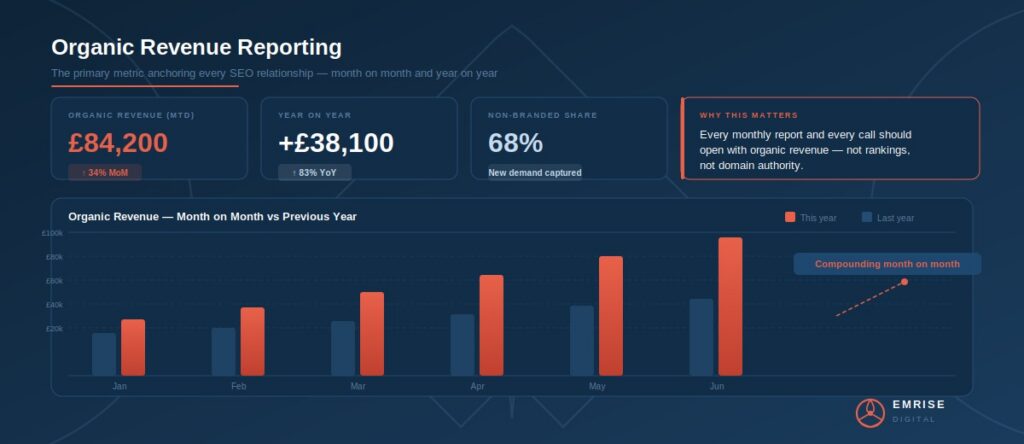
A lot of SEO reporting looks impressive and says very little. Rankings moving up, organic sessions increasing, domain authority growing. These are not business outcomes. They are indicators, and they are only useful when they connect to something that actually matters to your business.
The primary metric that should anchor every SEO relationship is organic revenue. Month on month and year on year. That comparison is what tells you whether the channel is genuinely growing or whether you are seeing seasonal fluctuation dressed up as progress. Every monthly report and every regular call should open with where organic revenue is, what is driving any movement, and what that means for the strategy going forward.
Organic traffic is a useful secondary metric. It helps explain the revenue picture and surfaces patterns worth investigating, a drop in traffic to a key collection page, a spike from a piece of content that is worth building on. But it should follow the revenue conversation, not lead it.
Beyond the numbers, good reporting should be interpretive. What changed, why it changed, what was learned, and what the agency is adjusting as a result. A report that narrates the same charts month after month without drawing conclusions or proposing changes is a sign that activity is being documented rather than a strategy being managed.
Before signing with anyone, ask what they will measure from day one and how that connects to your revenue. If the answer leads with rankings and traffic without any mention of organic revenue attribution, that tells you something important about how they define success.
An integrated team, not a collection of specialists
Most SEO agencies are good at identifying what needs to change. The gap is in implementing it. Technical recommendations sit in a backlog waiting for a developer. Content briefs are handed to freelance writers with no context about the business. Design and UX improvements get deprioritised because there is no one in the agency who can action them. The strategy is sound but the execution is fragmented, and fragmented execution is slow execution.
The question worth asking any agency is not just what they recommend but who actually does the work. Are developers in-house or outsourced? Who produces the content and how closely are they working with the SEO team? If UX or design changes are needed to improve conversion on a key landing page, can the agency handle that or does it come back to you to coordinate?
An agency that has SEO, content, development, and design working under one roof removes that bottleneck entirely. A technical fix identified on Monday can be implemented and tested by the end of the week. Content can be briefed, written, and optimised as a single joined-up process rather than a handoff chain. It also means the thinking is better from the start, because SEO strategy shaped by people who understand development constraints and design principles produces recommendations that are actually buildable.
For ecommerce businesses in particular, where site structure, page speed, collection page architecture, and content all interact directly with revenue, that level of integration is not a nice-to-have. It is the difference between a strategy that moves quickly and one that spends months waiting for implementation to catch up.
Flexible contracts with clear ownership
Reputable agencies retain clients through results, not contract terms. If an agency is confident in what they deliver, a rolling monthly arrangement should not be a problem. Long lock-in contracts with difficult exit clauses are a way of protecting the agency, not you, and it is worth being direct about this before signing anything.
Beyond contract length, be clear on ownership. Every piece of content produced, every analytics account set up, every tool configured during the engagement should belong to you. Some agencies retain access to accounts or assets when a client leaves, which creates unnecessary leverage and disruption at exactly the point when you are already dealing with a difficult transition. Ask explicitly what happens to your assets if the relationship ends.
Also be cautious of fixed-output retainers that lock you into a set number of blog posts and links each month regardless of what your site actually needs. SEO strategy should evolve as data arrives. What your campaign needs in month six may look completely different from what was scoped at the start. An agency working to a fixed deliverable list rather than a commercial outcome will keep producing the same outputs even when the evidence suggests a change in direction is needed.
The simplest test is this: if an agency is performing well, you will not want to leave. If they are not, you should be able to. A good agency knows that and structures their contracts accordingly.
Questions to Ask Before You Sign
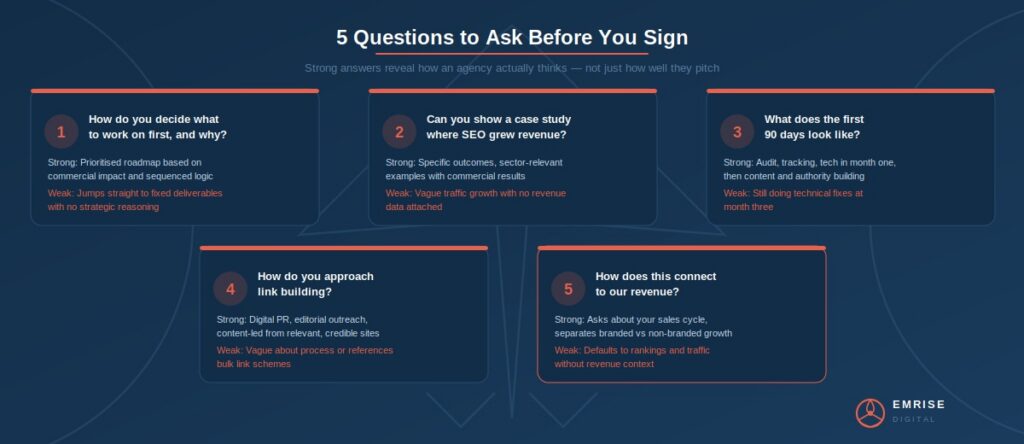
Most agency conversations follow the same pattern. The agency presents, you listen, and the questions asked at the end are polite rather than probing. The problem is that a well-rehearsed pitch tells you very little about how an agency actually thinks or what working with them looks like in practice. These five questions are designed to get past the presentation and into the decision-making.
1. How do you decide what to work on first, and why?
This is the single most revealing question you can ask. A strong answer covers discovery, technical triage, validating search intent, and building a prioritised roadmap based on commercial impact. It explains sequencing. Why collection pages before blog content. Why certain technical fixes are urgent and others are not. Why some keywords are worth targeting now and others can wait. A weak answer jumps straight to deliverables. A set number of posts, a set number of links, a fixed monthly output. If an agency cannot explain the logic behind the sequence, they are selling a process rather than a strategy.
2. Can you show me a case study where SEO contributed directly to revenue, ideally in ecommerce or a sector close to mine?
You are looking for specificity. What was the starting point, what was done, and what commercial outcome followed. Organic revenue growth, qualified leads generated, conversion rate improvements on key pages. Vague references to significant ranking improvements or strong traffic growth without a commercial outcome attached are not enough. Sector relevance also matters. An agency with genuine ecommerce experience will talk about collection pages, product page optimisation, and purchase-intent keywords. One without it will talk about blog traffic.
3. What does the first 90 days look like?
A strong answer covers audit, tracking validation, technical groundwork, keyword research, and early on-page optimisation, with clear milestones at each stage. Critically, any major technical issues should be identified and resolved within the first month, not stretched across a quarter. If an agency’s answer to this question is heavily weighted toward ongoing technical work beyond that initial phase, push back. The first 90 days should be about laying foundations quickly and moving into the activity that actually compounds: content and authority building.
4. How do you approach link building, and what kinds of links will you pursue?
Listen carefully here. Strong answers reference digital PR, editorial outreach, and content-led link acquisition from relevant, authoritative sites. The agency should be able to explain how they assess whether a site is worth pursuing and how they avoid low-quality placements that carry algorithmic risk. Weak answers reference bulk link schemes, are vague about the process, or frame link building as a volume exercise. If an agency is not comfortable explaining exactly how they build links and why, that lack of transparency will cost you eventually.
5. What do you measure, and how does that connect to our revenue?
A strong answer asks about your sales cycle, your current tracking setup, and how organic fits into your attribution model before giving you an answer. It distinguishes between leading indicators, such as improved rankings and stronger index coverage on key pages, and lagging indicators, such as organic revenue and organic-attributed conversions. It also distinguishes between branded and non-branded organic growth. A weak answer defaults to rankings and traffic without any conversation about how those metrics connect to what your business actually needs.
Red Flags That Should Give You Pause
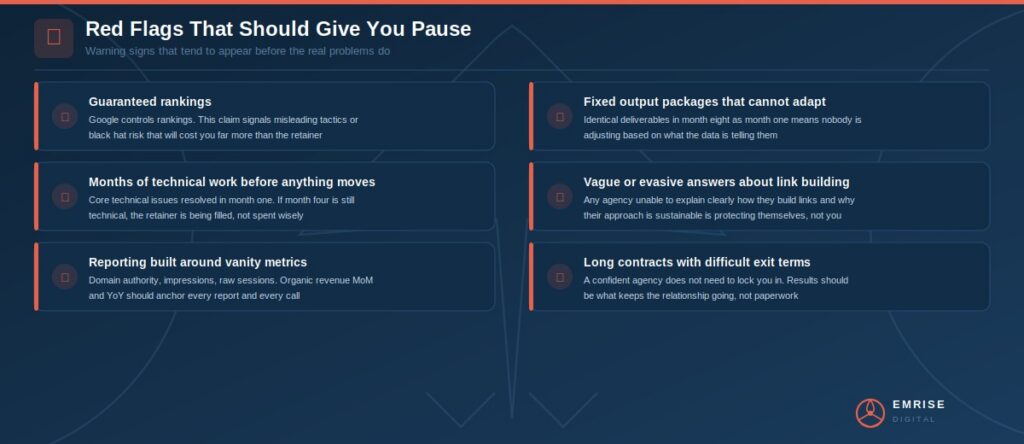
No agency pitch is designed to reveal its weaknesses. These are the signals worth watching for before you commit.
Guaranteed rankings. No legitimate agency can promise specific positions in Google. Search rankings are determined by Google, not the agency, and any business that tells you otherwise is either misleading you or planning to use tactics that produce short-term movement at the cost of long-term damage. Walk away from any conversation where guarantees are part of the pitch.
Months of technical work before anything else happens. As covered earlier, major technical issues should be identified and resolved within the first month. If an agency is still primarily focused on technical fixes three or four months into a campaign, that retainer is being filled with work that should have been done at the start. The activity that drives compounding results is content and authority building. An agency that never gets there is not delivering a strategy, it is delivering a to-do list.
Reporting built around vanity metrics. If the monthly report leads with domain authority, impressions, and raw organic sessions without any connection to revenue or conversions, the agency is measuring what is easy to show rather than what matters to your business. Organic revenue, month on month and year on year, should be the anchor of every update.
Fixed output packages that cannot adapt. A retainer that locks you into a set number of posts and links each month regardless of what your site actually needs is a warning sign. Strategy should evolve as data arrives. If the deliverable list looks identical in month eight to what was scoped in month one, someone is not paying attention.
Vague or evasive answers about link building. How an agency builds links tells you a great deal about how they operate. If they cannot explain clearly which sites they target, how they assess quality, and why their approach is sustainable, that vagueness is protecting them, not you. Poor quality link building is one of the few SEO mistakes that can actively damage your site rather than simply produce no return.
Long contracts with difficult exit terms. A confident agency does not need to lock you in. If exit clauses are buried, punitive, or difficult to find, the contract is structured around retention rather than performance. Results should be what keeps the relationship going, not paperwork.
The Right Agency Pays for Itself
Good SEO compounds. Strong technical foundations, content that captures buying intent, and authority built through credible links do not just produce results in isolation. They reinforce each other over time, and the return grows month on month as momentum builds. That is what makes the agency decision so consequential. The right choice accelerates that compounding. The wrong one delays it, sometimes by long enough that the cost goes well beyond what was paid in fees.
The framework in this guide will not make the decision for you, but it will help you ask the right questions, recognise the right answers, and spot the signals that tend to appear before the problems do.
At Emrise Digital, we take a revenue-first approach to SEO. That means commercial targets are set at the outset and used as the measure of success throughout. It also means our SEO thinking is shaped by genuine collaboration between developers, designers, content specialists, and SEO working under one roof, so recommendations get implemented rather than queued, and strategy is built around what is actually executable.
If you want to understand what an integrated SEO strategy could mean for your business, get in touch with our team today. You can contact us online, email us at [email protected], or call us on +44 0115 678 7377.


