

You’ve decided SEO needs to be part of your strategy. The harder question is who should be doing it. Do you hire someone in-house, build a team, or work with an agency? Both routes can work, but they suit very different businesses at very different stages.
The reality is that for large enterprises with nine-figure revenues, dedicated marketing departments, and the budget to support multiple specialist hires, building an in-house SEO team can make sense. But for the vast majority of ecommerce businesses, outsourcing to an agency delivers stronger results for less total investment, and without the operational overhead of growing an internal team.
That said, the quality of agency you choose matters enormously. Plenty of agencies take retainers and underdeliver. So this guide does two things: it helps you decide which model is right for your business, and if an agency is the answer, it covers what separates the ones that actually move the needle from the ones that don’t.
What’s the Difference Between In-House SEO and an SEO Agency?
In-House SEO
In-house SEO means hiring one or more people internally to manage your search engine optimisation. That person typically sits within your marketing team and takes ownership of everything from keyword research and content strategy to technical SEO and performance reporting. The appeal is straightforward: they’re embedded in your business, close to your brand, and available whenever you need them.
The reality is that SEO is not a single discipline. Technical SEO, content strategy, link building, and analytics are each specialisms in their own right. A single in-house hire, however talented, will inevitably have stronger footing in some areas than others. For most ecommerce businesses, expecting one person to cover the full picture is where the in-house model starts to show its limitations.
SEO Agency
An SEO agency is an external team of specialists who manage your SEO campaigns on your behalf. Rather than one generalist, you get access to people who work specifically in technical SEO, content, outreach, and analytics every single day, across multiple industries and client accounts. That breadth of exposure tends to sharpen instincts and accelerate results in ways that are difficult to replicate in-house.
For ecommerce businesses in particular, a good agency will understand the nuances of product page optimisation, category architecture, link building and brand authority, and the kind of content that converts browsers into buyers. The key word there is good. Agency quality varies significantly, and choosing the right partner matters as much as choosing the right model.
The Real Cost: In-House SEO vs SEO Agency
What an In-House Hire Actually Costs
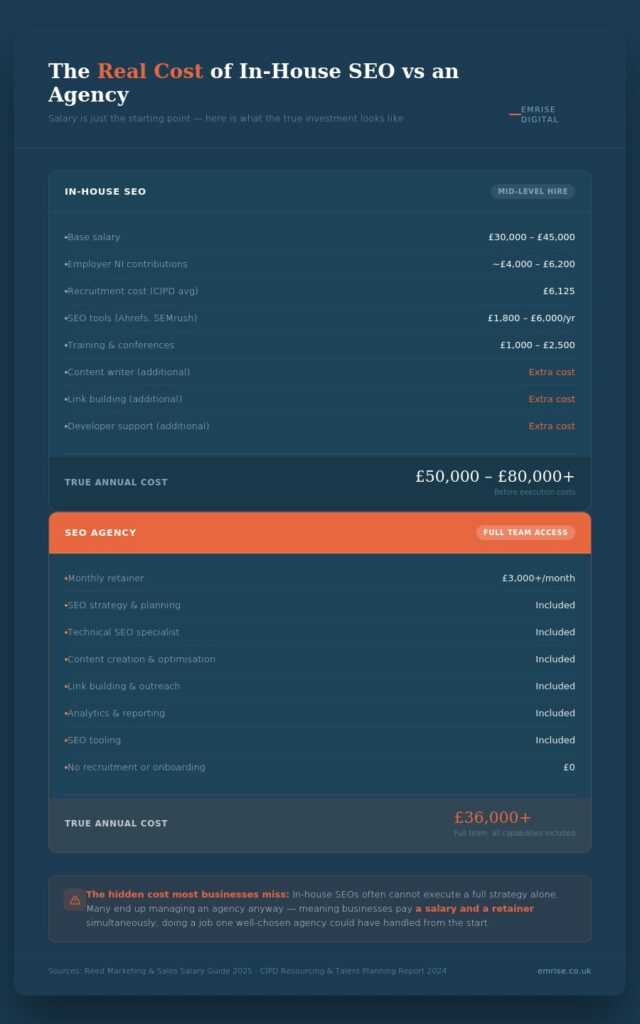
On the surface, hiring an in-house SEO can look like the more cost-effective option. A mid-level SEO manager in the UK typically commands a salary somewhere between £30,000 and £45,000 per year, with senior hires sitting closer to £50,000 to £70,000 (source: Reed Marketing & Sales Salary Guide). For businesses with the right structure, that investment can absolutely make sense.
Where the calculation gets more complex is when you factor in the full picture. Employer National Insurance contributions, recruitment costs where the CIPD puts the average UK cost per hire at £6,125, SEO tooling such as Ahrefs or SEMrush, ongoing training, and management overhead all add to the real cost of an in-house hire. There is also a natural onboarding period while a new SEO gets to grips with your website, audience, and competitors before they are operating at full capacity. None of this makes in-house the wrong choice, but it is worth going in with an accurate picture of what it truly costs.
What is rarely talked about is what happens next. An in-house SEO cannot execute a full strategy alone. They will need a developer to implement technical changes, a content writer to produce optimised copy, and a link builder to grow off-site authority. Those are either additional hires or additional costs on top of the salary you are already paying. In practice, what many businesses find is that their in-house SEO ends up managing an agency anyway, outsourcing the execution they do not have the internal resources to deliver themselves. At that point you are paying a salary and a retainer, two costs doing a job that one good agency relationship could have handled from the start.
What an SEO Agency Actually Costs
For most UK ecommerce businesses, SEO agency retainers typically start from around £1,000 to £1,500 per month at the entry level. However, if you are serious about results, it is worth understanding what a meaningful investment actually covers. A reputable agency delivering genuine performance will typically charge upwards of £3,000 per month once you factor in the real costs of running effective campaigns: content creation, link acquisition which is one of the most significant costs in any serious SEO strategy, account management, reporting, and the expertise of the specialists working across your account.
As with most things in business, you tend to get what you pay for. The agencies charging premium retainers are generally the ones investing properly in links, content, and the calibre of people working on your account. What you are actually accessing at that level is not one generalist but a full team of specialists, each with deep expertise in their specific discipline, working on your business from day one.
In-House SEO vs SEO Agency: Head-to-Head
Expertise and Specialist Knowledge
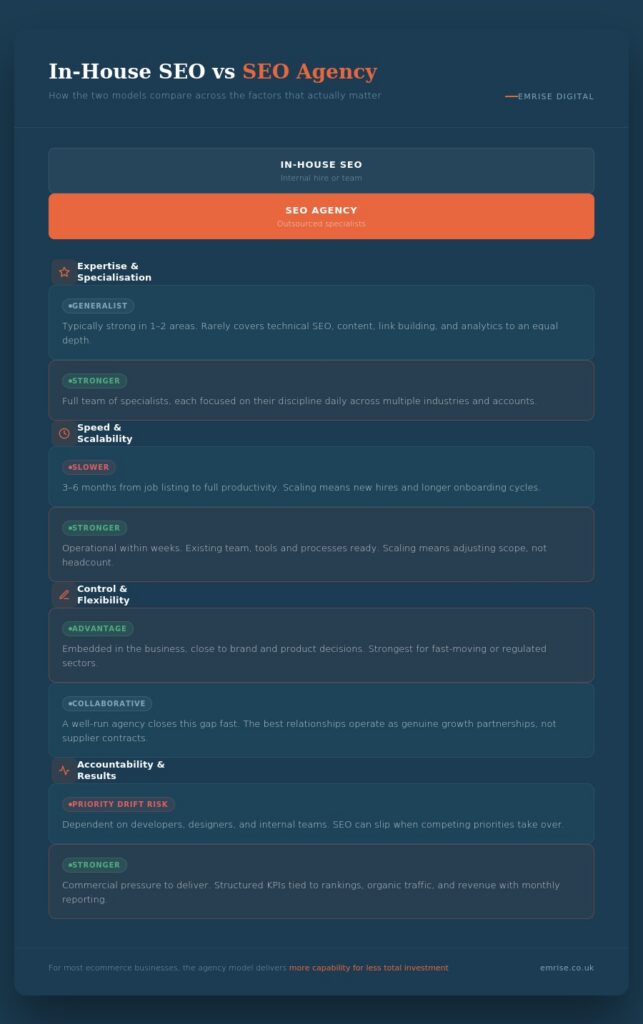
SEO is not one skill, it is several. Technical SEO, content strategy, link building, on-page optimisation, and analytics are each disciplines in their own right, and genuine expertise in all of them within a single hire is rare. Most in-house SEOs are strong in one or two areas and will naturally gravitate toward what they know best. That is not a criticism, it is just the reality of how broad modern SEO has become.
An agency brings a team where each person works in their specific discipline every day, across multiple client accounts and industries. That depth of focused experience is difficult to replicate in-house, particularly for ecommerce businesses where technical architecture, product page optimisation, and off-site authority building all need to work in tandem to drive meaningful results.
Control and Day-to-Day Flexibility
This is where in-house has a genuine edge. An internal hire is embedded in your business, close to product decisions, promotional calendars, and the conversations that shape your brand direction. For some businesses, particularly those in fast-moving or highly regulated sectors, that proximity is valuable enough to justify the in-house model on its own.
That said, a well-run agency relationship closes much of that gap. Regular communication, shared reporting dashboards, and a collaborative approach to strategy mean that a good agency should feel less like a supplier and more like an extension of your team. The best agency relationships go further than that entirely. They function as a genuine growth partnership, where the agency is as invested in your commercial outcomes as you are, proactively bringing ideas, spotting opportunities, and thinking about your business beyond the scope of a monthly deliverable. The businesses that get the least from agencies are often the ones that treat the relationship as hands-off once the contract is signed.
Speed and Scalability
Building an in-house SEO function takes time. From writing a job description to a new hire operating at full capacity, businesses should realistically account for three to six months before meaningful output. For an ecommerce brand with commercial targets and competitors actively investing in search, that is a significant window of lost ground.
An agency can move considerably faster. The team, tools, and processes are already in place, and onboarding typically takes a matter of weeks rather than months. Scaling is also more straightforward. Expanding an in-house operation means new hires, new onboarding cycles, and more internal management. With an agency, it largely means adjusting scope within an existing relationship.
Accountability and Measurable Results
Agencies operate under commercial pressure to demonstrate value in a way that internal hires often do not. That tends to mean structured monthly reporting, clear KPIs tied to keyword rankings, organic traffic, and revenue, and an ongoing obligation to show that the work is moving the needle. When results plateau or something is not working, a good agency will flag it and adapt.
In-house SEO can sometimes suffer from priority drift. A talented SEO working internally is still dependent on developers, designers, and content teams to get recommendations implemented. When those teams are pulled in other directions, SEO slips down the list. It is one of the most common reasons in-house SEO programmes underperform despite having capable people behind them.
Which Is Right for Your Business?
There is no universal answer, but there are clear patterns. The right choice comes down to your size, your budget, and what you actually need SEO to deliver for your business.
When in-house makes sense:
For large enterprises with significant marketing budgets, dedicated departments across multiple disciplines, and SEO deeply embedded in their product and brand infrastructure, building an in-house team can be the right call. At that scale, the volume of work justifies the headcount, and having SEO sitting inside the business makes operational sense. If you are running a nine-figure ecommerce operation with a full marketing department already in place, in-house is a legitimate and logical model.
When an agency is the stronger choice:
For the vast majority of ecommerce businesses, and particularly those in growth mode, an agency delivers more capability, faster, for less total investment than building internally. You get immediate access to a multi-disciplinary team, an established process, and specialists who have solved the same problems your business is facing across dozens of other accounts. There is no recruitment lag, no onboarding period, and no hidden costs stacking up behind a single salary.
This is particularly true for ecommerce brands where SEO results are tied directly to revenue. A good agency will treat your organic growth as a commercial priority, not just a marketing function.
What about the hybrid model?
Some businesses land on a middle ground, keeping a senior in-house person to own strategy and stakeholder relationships while an agency handles execution. This can work well when there is an experienced head of digital or marketing director who has the knowledge to manage an agency effectively and the time to do it properly. For most growing ecommerce businesses however, it adds a layer of cost and complexity that the results rarely justify.
What to Look for in an SEO Agency

Choosing the right agency matters as much as choosing the right model. The SEO industry has no shortage of agencies that are good at reporting activity but not particularly good at driving growth. Here is what actually separates the ones worth working with.
They measure success in revenue, not just rankings
Rankings and organic traffic are leading indicators, not outcomes. An agency worth its retainer will ultimately be focused on what that traffic is doing for your bottom line. If your organic revenue is not growing, the rankings are largely irrelevant. Look for an agency that sets commercial targets alongside search metrics and holds itself accountable to both. Monthly organic revenue growth is the number that should anchor every conversation, not how many pages were optimised that month.
They bring integrated expertise, not just SEO in isolation
SEO does not exist in a vacuum. Technical decisions made by your development team directly affect what Google can and cannot crawl. Content decisions affect how your pages rank and convert. An agency that operates alongside developers, designers, and content specialists will consistently find solutions that a standalone SEO agency simply cannot. At Emrise, having senior developers working alongside our SEO team has directly shaped how we approach problems for clients. A technical challenge like dynamic pagination on collection pages, something that has significant implications for how Google discovers and indexes ecommerce products, was solved collaboratively in a way that has since been deployed across multiple client accounts. That kind of joined-up thinking only happens when the disciplines are genuinely connected under one roof.
They understand your niche deeply enough to prioritise profitably
Traffic is not equal. For ecommerce businesses especially, the best agencies understand that different products carry different margins and that SEO strategy should reflect that. In the jewellery sector for example, branded watch pages might drive strong search volume but the margin on those products is typically slim. Whereas bespoke or own-brand pieces like engagement rings often carry significantly higher margins. An agency that understands this will build a strategy that prioritises organic visibility where it actually impacts profit, not just revenue. That level of commercial awareness is the difference between an agency that drives numbers and one that drives business growth.
They are accessible and proactive
A good agency should not feel difficult to reach. Monthly reporting is the baseline, but the best relationships involve regular calls, whether weekly or fortnightly, where results are talked through openly including what is working, what is not, and what is being tested next. Direct access to the people actually working on your account, not just an account manager relaying messages, makes an enormous difference to how quickly decisions get made and how well the agency understands your business over time.
If you are an ecommerce business weighing up your options about ecommerce SEO and want to speak with a team that measures itself on your revenue growth rather than a list of monthly deliverables, we would be happy to have that conversation.
Get in touch | [email protected] | +44 0115 678 7377
Frequently Asked Questions
Is in-house SEO cheaper than hiring an SEO agency?
Not when you factor in the full cost. A mid-level in-house SEO hire in the UK carries a salary of £30,000 to £45,000 per year before you add employer National Insurance contributions, recruitment costs, SEO tooling, training, and the additional resource needed to actually execute the strategy. Content writers, developers, and link builders all cost extra on top of that. A reputable SEO agency bundles all of that capability into a single retainer, making it considerably more cost-effective for most ecommerce businesses than building internally.
How long does it take to see results from SEO?
SEO is a long-term investment and it is important to go in with realistic expectations. Most businesses will start to see meaningful movement in keyword rankings and organic traffic within three to six months, with more significant revenue impact typically building from six to twelve months onwards. The timeline depends on factors like your current domain authority, how competitive your market is, and how quickly technical and content recommendations can be implemented. An agency with established processes and a dedicated team will generally reach that point of meaningful impact faster than a new in-house hire finding their feet.
Can I use both an in-house team and an SEO agency?
Yes, and for some businesses the hybrid model works well. It tends to suit companies that have a senior in-house head of digital or marketing director who can own the strategy, manage the agency relationship, and align SEO with broader business priorities. For most growing ecommerce businesses however, adding that internal layer alongside an agency retainer increases cost and complexity without a proportional improvement in results. If you do not already have a senior SEO-literate person in-house, going straight to a good agency is almost always the more efficient route.
What questions should I ask an SEO agency before hiring them?
The most important questions to ask are around how they measure success, what their reporting looks like, who will actually be working on your account day to day, and whether they have relevant experience in your sector. Ask to see case studies with real commercial outcomes, not just traffic charts. Ask how they approach Google algorithm changes and what their process looks like in the first 30 to 60 days. Any agency worth working with will answer those questions confidently and specifically. Vague answers about bespoke strategies and tailored approaches without any substance behind them are a red flag worth taking seriously.


