Digital marketing Archives - Emrise Digital

Your Guide to Form Design (That Actually Converts)

You’ve done everything right. Your ads are running. Your traffic is solid. Your product pages look great. And yet… people keep dropping off right before they buy. Sound familiar?

Nine times out of ten, the culprit is your forms.

Checkout forms, contact forms, newsletter sign-ups… They’re some of the most visited (and most abandoned) pages in any e-commerce store.

A poorly designed form doesn’t just feel annoying to fill out. It actively costs you revenue. The good news? Form design is one of the highest-ROI fixes you can make, and you don’t need a full redesign to do it.

Here’s your no-fluff field guide to forms that get completed:

Only Ask for What You Actually Need

Let’s start with the uncomfortable truth: most forms ask for way too much information.

Every extra field you add is another micro-decision you’re asking the user to make. The moment a form feels like homework, people bail.

Go through your current forms and ask yourself: “What happens if I remove this field?” If the answer is “nothing critical,” delete it. Do you really need a phone number for a newsletter sign-up? Does your checkout form need a second address line, a fax number, or a “how did you hear about us?” dropdown?

Quick win: Removing just one or two unnecessary fields can boost completion rates by 20% or more. Start there.

One Column Is Almost Always Better Than Two

It feels intuitive to stack fields side by side to save space. First name and last name next to each other, city and postcode in a row. But research consistently shows that single-column forms are completed faster and with fewer errors than multi-column layouts.

Why? Because our eyes naturally scan top to bottom. When you introduce a second column, you’re forcing the user’s brain to recalibrate its reading path and that tiny moment of confusion adds friction.

The only exception? Short, logically paired fields like credit card expiry date and CVV, where the visual grouping actually helps the user understand the relationship between the fields.

The rule of thumb: When in doubt, go single column.

Labels Go Above the Field Always

This one sound obvious, but you’d be surprised how many e-commerce sites still use placeholder text instead of labels or put labels to the side of fields.

Here’s the problem with placeholder-only labels: the moment someone clicks into the field and starts typing, the label disappears. Now they’ve forgotten what they were supposed to write. Cue the frustration, the second-guessing, and occasionally the tab close.

Labels should live above the input field, always visible, and written in plain language. Use placeholder text only as a secondary hint (like an example format), never as a replacement for the label.

Good label: Email address Good placeholder: e.g. hello@yourname.com Bad idea: Placeholder only, no label.

Email form field with visible label and placeholder text on a dark navy background.

Write Error Messages Like a Human

Nothing kills momentum like a cold, robotic error message: “Error: Input invalid.”

Well, Thanks for nothing…

When someone makes a mistake on your form (and they will) your error message is a customer service moment. Handle it well and they’ll fix it and move on. Handle it badly and they’ll assume your whole brand is this frustrating to deal with.

Good error messages do three things:

  • Appear inline, right next to the field where the problem is (not at the top of the page in a vague red banner)
  • Tell the user what went wrong in plain language
  • Tell them how to fix it

Compare these two:

“Phone number is invalid.”  

“Looks like there’s a digit missing — UK numbers should be 11 digits long.”

One feels like a wall, the user will know something is wrong but what exactly? The other feels like help, as it’s pointing for the exact mistake and how to solve.

Make Your CTAs Earn Their Click

Your submit button is doing a lot of heavy lifting. Don’t waste it.

Generic labels like “Submit” or “Continue” tell the user nothing about what happens next. They’re vague, they feel bureaucratic, and they subtly increase anxiety, especially on checkout pages where people are about to hand over their card details.

Instead, use action-oriented language that reinforces the value the user is about to receive:

  • “Complete My Order” beats “Submit”
  • “Get My Free Guide” beats “Sign Up”
  • “Start My Free Trial” beats “Continue”

The button should also be impossible to miss. High contrast, full width on mobile, and placed where the user’s eye naturally lands after filling the last field. Don’t make them hunt for it.

Show Progress on Multi-Step Forms

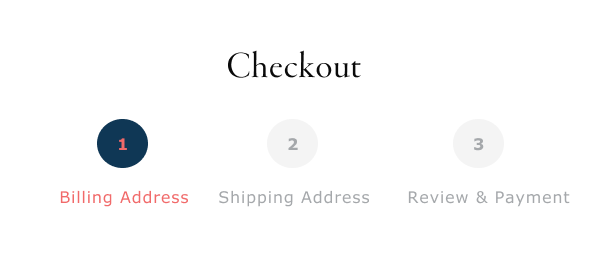
If your checkout process is more than one step (and for most e-commerce stores, it is), a progress indicator is non-negotiable.

Humans are goal-oriented. We’re far more likely to finish something when we can see how close we are to the end. A simple “Step 2 of 3” or a visual progress bar gives users that sense of forward momentum — and dramatically reduces abandonment mid-flow.

Keep each step focused on one category of information (personal details, shipping, payment) and avoid dumping everything onto one overwhelming screen.

Bonus tip: Lead with the easiest fields first. Email and name before card details. Once someone has invested a couple of minutes filling out a form, they’re much more likely to finish it.

Three-step checkout progress indicator showing Billing Address, Shipping Address, and Review & Payment, with step one active.

Design for Mobile First and then Desktop

Over 70% of e-commerce traffic now comes from mobile devices. But most checkout forms were designed for a desktop experience and then awkwardly squeezed onto a small screen.

Here’s what good mobile form design looks like in practice:

  • Tap targets (buttons and input fields) are at least 44x44px — large enough to hit without zooming in
  • The correct keyboard type is triggered automatically (numeric for phone/card fields, email keyboard for email fields)
  • Fields are spaced so your thumb doesn’t accidentally tap the wrong one
  • Autofill is enabled so returning users can breeze through

If you’ve never tested your own checkout form on a real phone, do it right now. You’ll probably find at least three things to fix immediately.

The Bottom Line

Great form design isn’t about making things look pretty. It’s about removing every possible reason for someone to give up. Every unnecessary field, every confusing label, every robotic error message is a tiny leak in your conversion funnel.

The good news is that most of these fixes are quick to implement and fast to show results. You don’t need a new platform or a six-month redesign project. You need to look at your forms with honest, critical eyes.

Start with your checkout form. Fix the obvious friction points. Test, measure, and iterate.

Your future customers will thank you by actually completing their purchase.

Want us to audit your current forms and find out where you’re losing conversions? Get in touch we’d love to take a look.

Your customers are using AI to shop. Is your store ready?

Most e-commerce brands are still optimising for a customer journey that fewer and fewer people are actually taking. The assumption of browse, search, compare, click, buy made sense for a long time. That is changing, and faster than most brands have accounted for.

A growing share of your customers are now starting that process somewhere else entirely: inside an AI. They’re asking ChatGPT what to buy for a wedding anniversary, letting Perplexity compare luxury candles and asking Gemini to find the best-reviewed gifts under £100. For most shoppers today, AI is still playing an advisory role. It surfaces options, compares products and shortlists choices before the customer makes the final decision. But the share of that decision-making happening inside AI tools, rather than on your store, is growing fast.

This isn’t a prediction. It’s already happening, and most brands have two significant blind spots at once.

The discovery problem

AI shopping agents don’t browse the way humans do. They don’t scroll category pages or respond to homepage banners. They pull structured data, parse product feeds and make decisions based on what they can actually read and verify. If your product information is incomplete, inconsistent or missing key attributes, agents may not flag it. They move on, and your competitor gets surfaced instead.

The scale of this shift is already showing up in traffic data. AI-referred traffic to retail sites grew 693.4% across the 2025 holiday season, according to Adobe Analytics, though it’s worth noting this is from a low base. eMarketer forecasts AI platforms will drive $144 billion in e-commerce sales by 2029, nearly 9% of all US retail e-commerce. eMarketer also projects that 20% of all online transactions could be initiated by AI agents by the end of this year, a figure echoed by Gartner, though “initiated” covers a wide range of behaviour, from an AI recommendation that leads to a click through to fully autonomous purchasing, which remains rare.

A joint study by IBM’s Institute for Business Value and the National Retail Federation, surveying 18,000 consumers across 23 countries, found that 45% are already using AI somewhere in their buying journey. Adyen’s 2026 UK Retail Report found that 44% of UK shoppers are now open to having AI handle the entire shopping process, including the final purchase, once their preferences and budget are set. This is a shift still in progress, but the direction is clear.

A meaningful and fast-growing portion of your addressable market is making purchase decisions in an environment where your product content needs to work harder than ever.

The brands currently performing well in these environments aren’t necessarily the biggest or the best-known. They’re the ones whose data is structured, complete and consistently maintained across every feed and platform. Missing dimensions, vague product descriptions, absent review data and unstructured specifications are no longer just bad for traditional SEO. As AI search becomes a more significant part of how products are found and evaluated, the stakes attached to data quality have risen considerably.

Maintaining that consistency across feeds, platforms and a constantly changing product catalogue is demanding but increasingly essential.

Person browsing ecommerce products on a laptop.

The experience problem

The expectations of customers who still land directly on your store are also shifting.

People who regularly use AI tools in their daily lives, for research, for recommendations, for planning, are increasingly accustomed to experiences that feel relevant to them specifically. Not just “personalised” in the sense of a name in an email subject line, but genuinely tailored. Recommendations that reflect their actual preferences, interfaces that surface what they’re likely to want before they go looking for it.

When those customers arrive on an e-commerce site that doesn’t match that experience, the gap is noticeable. According to Adobe Analytics, visitors referred from AI platforms convert at a rate 31% higher than average and generate 254% more revenue per visit, suggesting that when the experience matches the expectation AI has already set, shoppers are significantly more ready to buy. Customers who don’t get that experience are increasingly likely to leave without converting, having been conditioned by AI-assisted experiences to expect something better.

This isn’t a feature problem. It’s a foundations problem.

Brands that are getting this right aren’t deploying one big solution. They know what a returning customer looks like, and they can adjust what products are shown and in what order.

Woman with a book using a mobile phone for research.

The visibility gap

What makes this difficult is that the signals don’t always show up where you’d expect them to. AI referral traffic, Google AI Overviews and brand visibility across recommendation platforms are increasingly trackable, but the picture is rarely complete, and interpreting it requires a different kind of attention than reading a standard analytics dashboard.

The earlier part of the funnel is harder still. When AI tools evaluate products during the recommendation phase, that process doesn’t show up in your usual reports. The gap tends to surface indirectly, in conversion rates that don’t quite add up or revenue that’s hard to account for directly.

As McKinsey notes, most brands are still running personalisation efforts as manual, one-off experiments rather than measuring them in any integrated way, which means the effect often gets absorbed into overall performance numbers without a clear cause.

What ties all of this together is the quality of the foundations underneath. Structured product data, clean feeds, solid SEO and proper analytics infrastructure are what influence visibility in AI search and traditional search alike. The brands least likely to face these problems are those who’ve already got that groundwork in place.

These things compound over time. AI systems learn which products and brands to surface based on data quality and engagement signals. Stores that aren’t visible or competitive in AI-referred channels today will become progressively less so. The window to build the right foundations is narrowing.

It is also where the right expertise makes the most difference.

AI hasn’t changed what good e-commerce looks like at its core: relevant products, trustworthy information, a smooth path to purchase.

Emrise works with e-commerce brands on the foundations that influence both search visibility and AI recommendation, from structured product data and technical SEO to analytics and measurement. Get in touch to find out where your store stands.

The New Rules of Social Discovery in 2026 (And What It Means for Your Business)

Most brands are still running a 2019 social strategy on 2026 feeds. They’re chasing likes and followers, posting as often as possible and calling it a social strategy, while the platforms quietly put most of that content in front of people who don’t actually follow them.

The data from platform benchmarks and industry research has been building steadily in one direction: discovery on social media is now driven by the platforms themselves, serving content to people who haven’t come across you before instead of your existing audience. Creative quality and entertainment value are what drive results. That shift changes how you brief, how you distribute and how you measure social. Here’s what it means in practice, and what to do about it.

Rule 1: Optimise for New Audiences, Not Just Your Existing Followers

On TikTok, views coming from the For You page jumped from 31% to 58% between 2023 and 2025. On Instagram, views from non-followers grew from 30% to 49% between 2024 and 2025. The platforms are actively serving your content to people who have never heard of you, so your current followers are a starting point, not the ceiling.

That has real implications for how you approach every piece of content. Everything has to work for newcomers. Hooks can’t rely on brand familiarity, captions can’t assume context. The creative has to earn attention from someone scrolling past dozens of other videos.

Practical moves:

  • Before every post, ask yourself whether it would still work if you removed your logo and brand name – if the answer is no, the hook needs rethinking
  • Plan your content calendar with new audiences in mind, not just the people who already follow you

Rule 2: Creative Quality Is Now an Algorithm Signal

Content that entertains keeps people watching longer, and average watch time on TikTok and Instagram has increased from around six to nine seconds as feeds have become more entertainment-led. That might sound modest, but watch time is one of the clearest signals platforms use to decide how widely to share your content. Better creative doesn’t just land better with viewers; it earns broader reach from the platform itself.

This means the creative brief matters more than the posting schedule. A single well-crafted video with a strong hook, a clear payoff and a format that feels at home on the platform will consistently outperform multiple mediocre posts. The more useful question isn’t how often to post, but what would make someone stop, watch and come back.

Practical moves:

  • Invest more time in the first one to two seconds of every video, because that’s where watch time is won or lost
  • Use watch time and completion rate as your primary creative quality signals, rather than likes or the raw number of people who saw the post
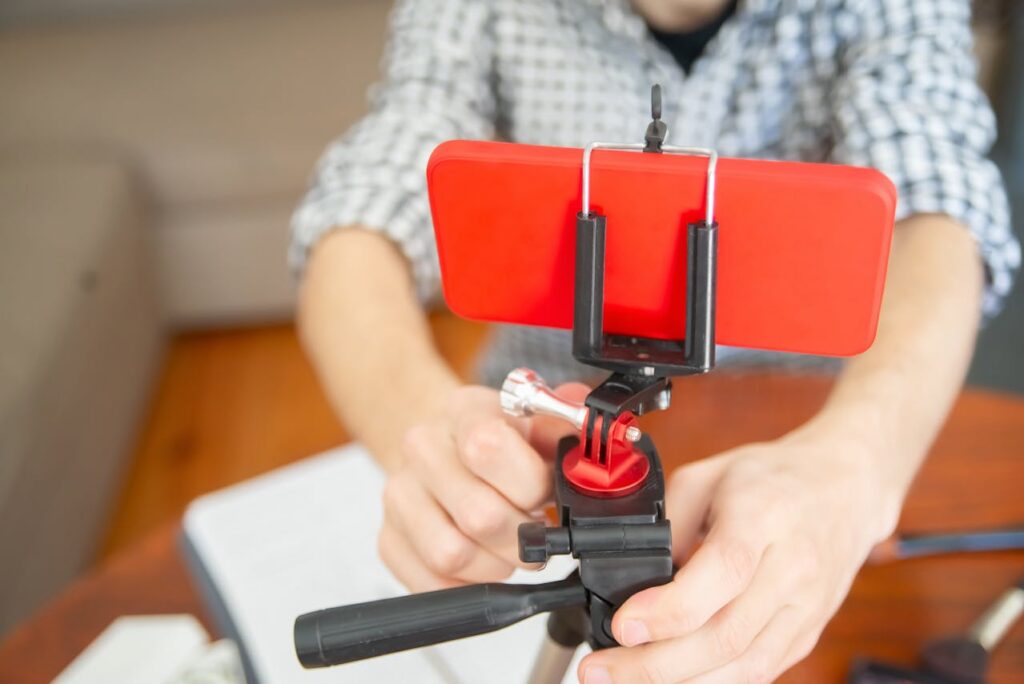
Person setting up a smartphone on a tripod ready to record video content

Rule 3: Platform Strategy Can’t Be Copy-Pasted

Different brands get results from different channels, and what works depends on the brand, the audience and the platform’s current priorities. Crucially, each platform has its own native format, and that format is part of the message. Content that feels at home on TikTok and the same content reformatted for LinkedIn are not identical, even if they use the same words. This distinction should be a central part of your brief from the start, not just a finishing step.

TikTok rewards fast-paced, creator-style content and is currently the strongest channel for reaching audiences new to your brand. Instagram still performs well for polished visual brands but increasingly rewards short-form video over static posts. LinkedIn, YouTube Shorts and Pinterest each have their own audience expectations and content logic.

Practical moves:

  • Audit which platforms are driving discovery and new customers for your specific brand before spreading budget thin
  • Build platform-specific creative briefs rather than one master brief with the format decided as an afterthought

Rule 4: Creators and User-Generated Content Are Worth Taking Seriously

In just two years, the share of social impact coming from content made by real customers and creators, rather than by brands directly, grew from 8% to 13%. On purchasing behaviour, 43.8% of TikTok users made at least one purchase through the platform in 2024, the highest rate of any social channel. At a market level, UK social commerce is forecast to reach £11.75 billion in 2026. These are not numbers confined to fashion or beauty; they are showing up across categories, including B2B and industries that have historically kept social at arm’s length.

This isn’t about chasing influencers with millions of followers. It’s about building a small, relevant group of creators and customers who speak the language of your buyers and show your product in real-world contexts. Start with a handful of people who genuinely understand your audience, brief them on what you want to achieve and hold the results to the same standards, as you would any other marketing channel.

Practical moves:

  • Identify a small group of creators or customers who genuinely understand your audience and start with clear, outcome-focused briefs
  • Repurpose top-performing creator content into paid campaigns, rather than only boosting polished brand creative

Rule 5: Post Less, Distribute More

Brands posting fewer than six times per week see 13% higher engagement on Instagram and 63% higher engagement on TikTok compared to higher-volume accounts. The data consistently shows that posting more often does not lead to improved engagement but actually tends to reduce it. Posting less isn’t laziness; it’s strategy.

Low-effort content doesn’t just underperform; it trains the algorithm to expect less from you. The shift worth making is from five posts a week to three genuinely strong posts, each with a clear plan for how they’ll reach people beyond your existing followers. That means putting paid promotion behind your best content, working with creators to extend its life, reusing it across formats and testing different opening lines to see what performs best. The goal isn’t to keep a posting schedule ticking over; it’s to get the most from content actually worth making.

Practical moves:

  • Audit your last 30 days of content and cut the bottom third of ideas from future calendars
  • Reallocate that time into stronger creative development, better editing and testing what resonates
Person holding a tablet displaying a bar chart showing monthly growth data

Measure Discovery, Not Just Followers

There has been an important shift in how platforms measure content performance. While your content has always had the potential to reach people who don’t yet follow you, platforms now factor in non-follower engagement when they decide how widely to distribute your content. Whether they save it, share it, rewatch it or click through, those responses all count. People who have never heard of your brand but engage with your posts now play an important part in growing your reach over time.

As a result, many standard social metrics are now less useful than they appear. Follower growth is a measure of the past, and posting volume doesn’t reflect the effectiveness of your strategy.

A more useful model looks at:

  • Discovery impressions – how many people who don’t follow you are seeing your content
  • Profile visits and link clicks from content – are they driving genuine interest?
  • Saves, shares and rewatches – signals that content is worth returning to or passing on
  • Wider effects – uplift in people searching for your brand, direct traffic or sales that correlate with your content activity

The useful question when reviewing social performance isn’t how many posts went out, but which pieces of content are reaching new people, and what do they have in common.

What to Do Now

The platforms have changed their incentives. The content that gets distributed widely now earns its reach by connecting with people who weren’t already looking for you. Your strategy should no longer focus only on keeping existing followers engaged.

If you’re still planning social around follower growth and posting volume, it’s worth taking a closer look at how the platforms work in 2026. Working with creators and customers as part of your wider marketing mix, shifting from more posts to better posts with a clearer distribution plan, and designing content for new audiences rather than existing ones – this is what’s working right now.

Social strategy doesn’t sit in isolation either. If you want to see how these shifts connect to what’s actually driving e-commerce sales in 2026, our e-commerce statistics post covers the broader picture, including the social commerce data. And if you’re thinking about how social fits into your wider marketing mix, our piece on what’s working in 2026 is worth a read.

If you want help rethinking your social strategy around discovery, from creative to distribution to reporting, get in touch with the Emrise team at hello@emrise.co.uk or call 0115 678 7377 and we’ll build a plan that works for your market and your team.

A note on sources: The For You page, non-follower reach, user-generated content share and posting frequency figures in this piece are drawn from Dash Social’s 2026 Social Media Trends Report, published February 2026. The TikTok social ecommerce purchase rate is from eMarketer, via Hootsuite’s TikTok statistics. The UK social commerce forecast is from eMarketer.